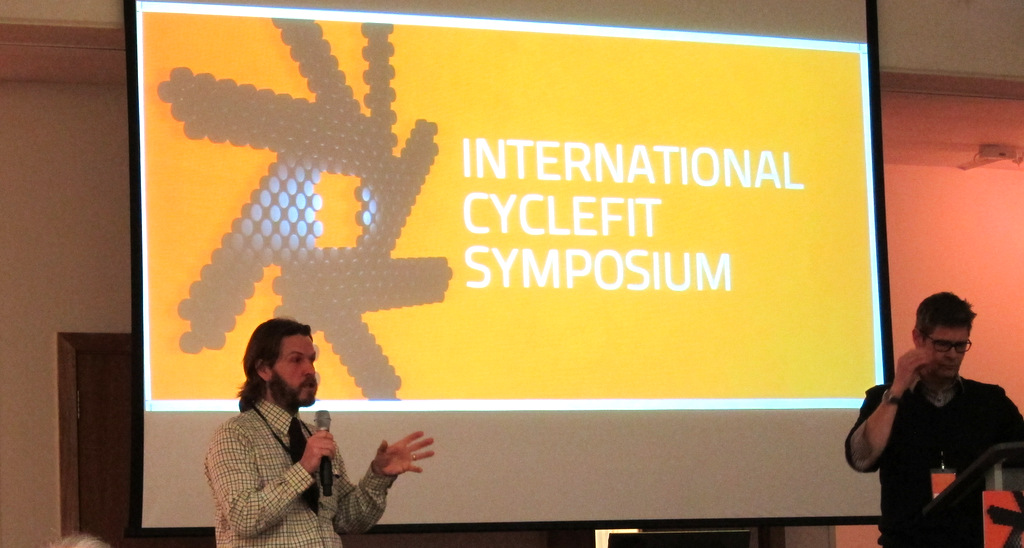
 I’m at the International Cyclefit Symposium presented by Cyclefit – one of Seven Cycles’ retailers in the UK. This is their second year of bringing together the best fitters and technicians in the world. It is the only fit gathering of its kind; I have to go to London to talk about the bleeding edge of bike fit. That seems a bit odd to me — that I have to leave the U.S. to talk about the best ideas in fitting. But, I’m excited to spend time with Cyclefit and talk with other bike fitters about the state of the art.
When: January 24-26, Thursday, Friday, and Saturday
Where: Brunel University, Uxbridge, England
Why: Work with the best fitters and newest fitting technologies in the world.
My favorite quote of the week:
“You are part of the solution or you are part of the problem. You are not part of nothing.” – Jon Iriberri. Talking about racers and how they want to have the fitter fix whatever is wrong. Racers don’t want to be bothered with doing exercises, evaluate changing their positions or pedaling styles, etc. They just want the fitter to deal with it. For some reason it doesn’t work that way.
Update: Friday’s Session
- Last night I was asked to present at the Symposium because Phil thought a presenter was not going to show. Alas, that person showed up so I’m off the hook. I was flattered to have been asked. Maybe next year.
- I’m surprised that there is no longer anything like this in the US. Cyclefit is carrying the mantel of fit study and practice that the US began. Thank you Cyclefit.
- I’m impressed with all the presenters. They were willing to acknowledge that they don’t hall the answers – and in many cases they don’t have any answers. So little data to support hypothesis but at least that were up there proposing hypotheses.
- The majority of the presenters work in the top 0.01% of population. So some of the work is not super applicable to my primary interests of having more people more happy with the way their bikes work; fit being an important aspect of this. Evaluating optimized saddle height for Olympic track sprinters is not 100% transferable to the majority of the riders with which I work.
- There was a lot of, “I don’t know why this works but it seems to.” And, “We don’t have sufficient data but we think x is true.” I really appreciated people’s openness about what they’re up to and that they don’t have all the answers.
-
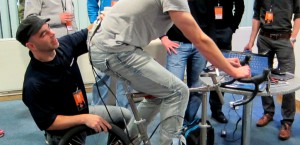
Curtis Cramblett working on pedal stroke
One of the most interesting parts of the symposium for me was watching Curtis Cramblett do a bit of fit diagnosis, on the fly, during one of the breaks between presentations. More on this later.
- Seeing the thin data presented – or no data presented – I felt good about the work that Seven Cycles has done over the past 15-years. With a 25,000 customer database that Seven’s generated. I wager that, overall, no one has better, or more data, than Seven has gathered. We still have a long way to go but at least we’re not behind.
- A lot more I’d like to write but I need some sleep soon.
Update: Thursday’s Session
Some quick notes from Thursday’s presentations, lunch meetings, and dinner meetings:
- I was asked at the last minute, literally, to cover for someone that might not show for tomorrow. I have a bunch of ideas on what I could discuss for 90 minutes. Phil told me not to prepare anything.
- There are too many companies working on next generation fit tools. I think the technology has just made some major advances. I’ve never been very interested in any of the tools that exist up until now. In the next six months I think you’ll be seeing some really interesting advances. Of course, no tool makes up for experience. My favorite tools are still my ears, hands, and eyes.
- A lot of foot pressure measuring tools coming out. All interesting and some more useful than others. Shimano’s new system is about to arrive, too.
- A common standard for fitters is knee angle. This continues to frustrate me. For example, Retul uses a knee angle of 37-42 degrees as the target. It’s been a while since I’ve done math on how five degrees affects saddle height but, if memory serves, it’s something like 4 cm of saddle height for a male of average height. So, using angles is not really very accurate. This range they recommend is not really helpful at all. I don’t mean this as a statement about Retul; every system I know of uses a knee angle range that has this same challenge.
{ 0 comments… add one now }
You must log in to post a comment.